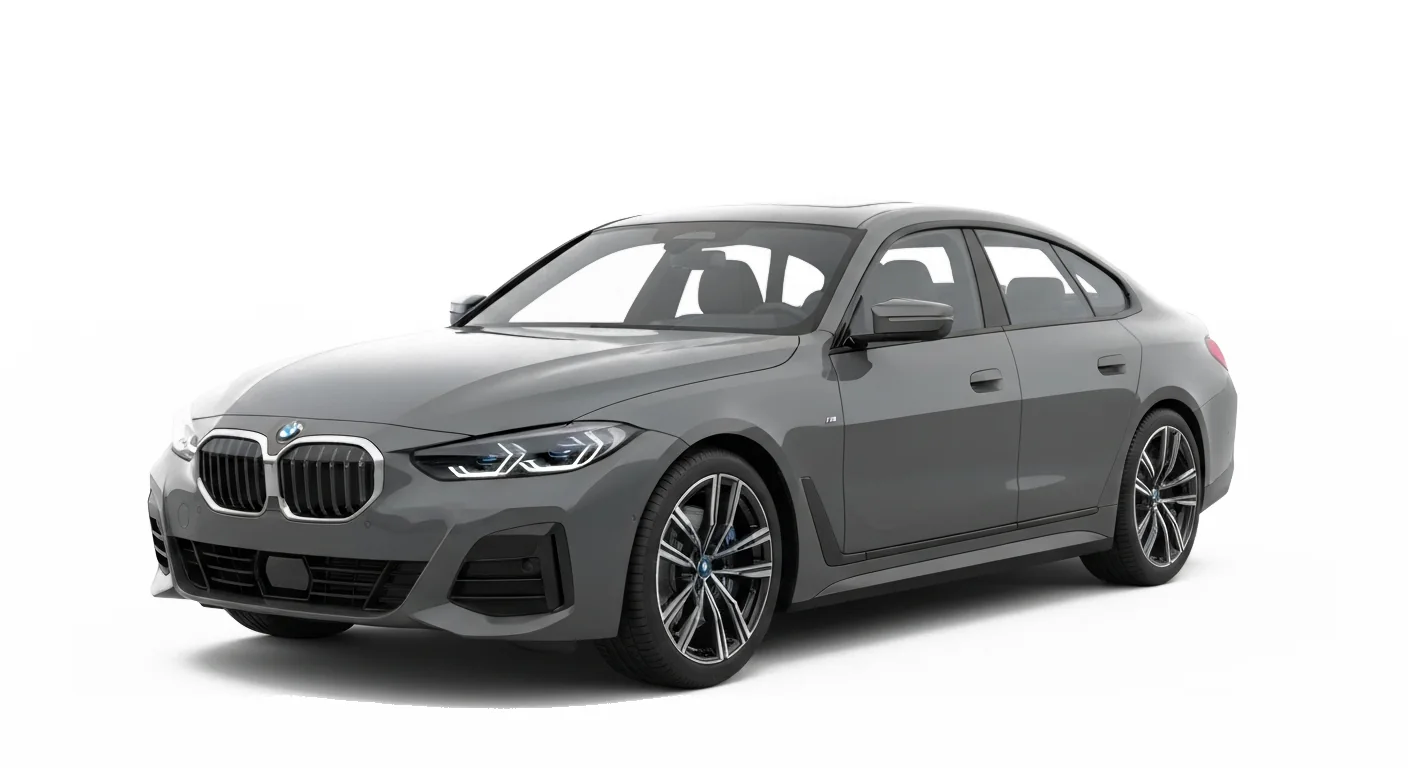
2026 i4: confirm the build specification before comparing versions
BMW’s US model-year announcement replaces the i4 M50 with the M60 and introduces more efficient power electronics. An advertisement or catalogue entry still labelled M50 therefore needs its build date, market and model year checked. Registration year alone does not resolve which specification you are buying.
The announcement gives the eDrive40 preliminary range estimates of 333 miles on 18-inch wheels and 307 miles on 19-inch wheels. That 26-mile difference is about 8% of the smaller-wheel estimate, despite the same model badge. BMW labels these as its own preliminary tests using EPA procedures, not final EPA ratings.
Our buying interpretation: compare wheel packages before treating two i4 prices as like-for-like, and request the original specification sheet for an M50/M60 listing. The legacy figures in the catalogue are not automatically validated by this announcement, and these US estimates should not be substituted for European WLTP figures.
Research by CarsbySpec, checked . Source: BMW Group — 2026 BMW i4 update measures — 6 November 2025. US model-year changes and preliminary range estimates; not a source for every catalogue field.
Verdict
2026 BMW i4 earns 6.7/10 in the CarsbySpec specification-led assessment and places 17th of 28 among nearby electric sedans. Practicality is its strongest measured area. Performance is the principal numerical compromise.
There is not enough consistent price data to calculate a defensible value rank for this model year.
This makes the review useful for building a shortlist, but it cannot answer questions that require driving the car. Ride comfort, cabin noise, steering response, braking consistency and material quality should still be checked in person.
Performance
The eDrive40 version used as the baseline records 340 hp, 430 Nm of torque, 5.6 seconds from 0-100 km/h, and a 190 km/h top speed. Its power output ranks 18th of 28 among entries with comparable data. Its acceleration ranks 17th of 28 among entries with comparable data.
These figures describe straight-line potential only. They do not reveal brake feel, grip in poor conditions, steering accuracy, stability or how consistently the car performs after repeated acceleration and braking.
Range, efficiency and charging
The recorded energy picture includes 600 km of listed electric range, a 83.9 kWh battery, 205 kW maximum DC charging, and 15.4 kWh/100km recorded consumption. Its listed range cannot be ranked because too few comparable entries contain that figure.
Range measurement: Test cycle unverified. Range and consumption only contribute to comparative scores when their test cycles are verified and match. Maximum charging power describes a peak, not a charging time.
Interior space and everyday usability
For daily use, the specification lists 470 litres of cargo capacity, 5 seats, and a 2,055 kg curb weight. Its cargo capacity ranks 12th of 28 among entries with comparable data.
Capacity figures still need context: a large boot can be compromised by a narrow opening or high floor, and a seat count does not establish adult comfort. Those points require an inspection rather than a spreadsheet.
Safety and driver assistance
CarsbySpec does not yet hold a verified independent crash-test result matching this exact model year, generation and market. The car may be untested, tested under another name or specification, or still awaiting source review. Missing data is not treated as a zero score.
CarsbySpec does not treat curb weight, drivetrain or driver-assistance marketing as proof of crash safety. Before buying, verify the exact market version, standard safety equipment and outstanding recalls; a result from another generation is never silently reused.
Used-buying checks and recall research
CarsbySpec has not yet stored a sourced fault record that can be safely attached to this exact model year and generation. That is a coverage gap, not evidence that the car is fault-free.
Inspection checklist for this powertrain
These are general inspection steps for a electric car, not a list of reported BMW i4 faults.
Recall status and service campaigns can change after publication. Check the exact VIN with the manufacturer or the relevant national authority, and use an independent pre-purchase inspection.
Price and value for money
The baseline starting price is $53,900 USD. That price cannot be ranked because too few comparable entries contain that figure. There is not enough consistent price data to calculate a defensible value rank for this model year.
The value score combines starting price with performance, range and cargo figures where available. It does not assume identical taxes, incentives, warranties, servicing or standard equipment across countries, so local quotations still matter.
Which version should you choose?
There are 3 recorded 2026 versions. The table preserves the differences between them. A value pick is withheld until price markets and range measurements can be matched. Confirm equipment and a local quote before choosing.
| Version | Power | 0-100 | Range | Price | Assessment |
|---|---|---|---|---|---|
| i4 eDrive40 | 340 hp | 5.6 s | 600 km | $53,900 | |
| i4 M50 | 544 hp | 3.9 s | 510 km | $67,300 | |
| i4 M50 xDrive | 544 hp | 3.9 s | 520 km | $67,300 |
Specification sources
Primary-source links for this version’s recorded specifications have not yet been attached. Treat the figures as catalogue references and confirm the exact market, model year and equipment with the manufacturer before a purchase.
How data and scores are checkedWhich similar car is best?
The highest overall specification score in this electric sedan group belongs to the 2026 Tesla Model S at 8.7/10. These are data-led results, not universal buying recommendations.